
13 September 2026
How to Meet People in a New City
Moving somewhere new is two experiences wearing the same coat. There is the version in your head, where you arrive and the city opens up. And there is the actual first month, where you know the route to work, the nearest supermarket, and roughly four people, three of whom you met at work and one of whom is your landlord.
It is not a personality problem. Adults do not make friends the way children do, because the thing that made it easy has gone: you no longer spend three hundred unplanned hours a year in the same room as the same people. Nobody replaces that by being more outgoing. You replace it by manufacturing the conditions on purpose.
Why the usual advice does not work
The standard suggestions are “put yourself out there” and “say yes to everything”. Both assume there is something to say yes to. In a new city there usually is not, at least not yet, and that is the actual bottleneck. You do not need more courage. You need a plan on a specific date, in a specific place, with people who also want a plan.
The second problem is the shape of the thing. Meeting one stranger for coffee is high-stakes and low-yield: if the conversation does not spark, the whole evening was that conversation. Doing an activity with a few people is the opposite. The activity carries the talking, nobody is being evaluated, and if you only click with one person out of five, that is still a win.
Start by joining, not hosting
The instinct when you are new is to wait until you know the city well enough to organise something. Skip that. Joining is the low-effort move, and in a place you do not know yet it is also the more useful one, because the person hosting has already solved the hard parts: they picked the venue, they know it is any good, they chose the time.
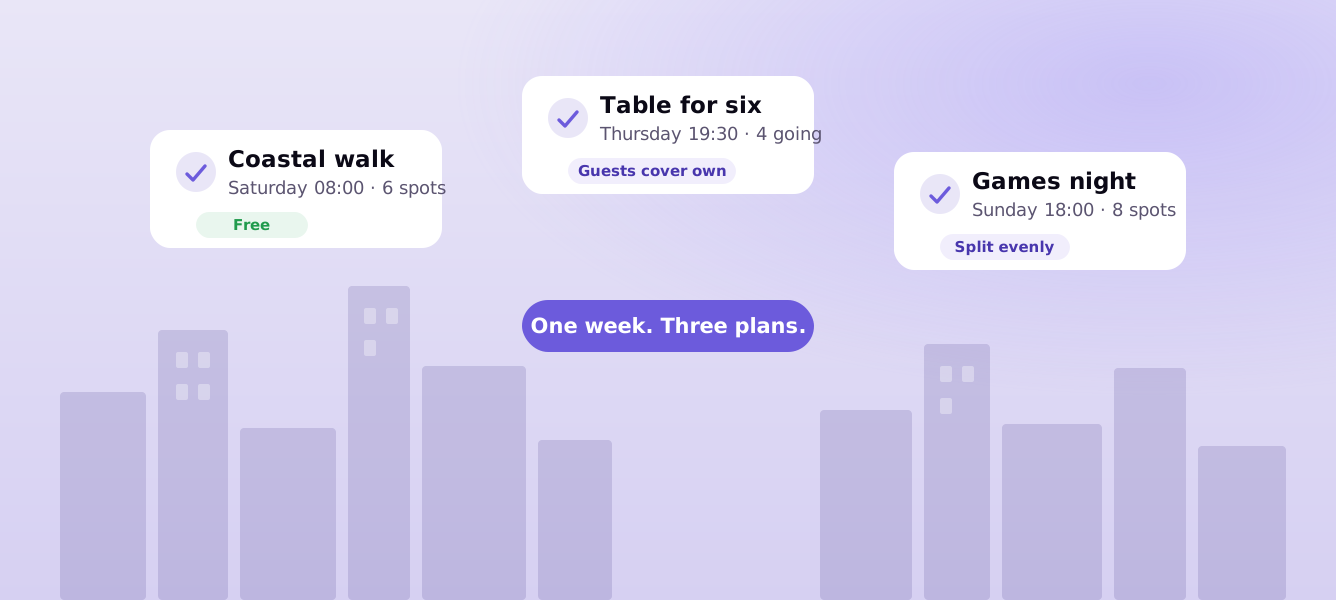
On Tolivi, browsing shows you what is actually happening near you. Not profiles to evaluate, but plans with a shape: a hike on Saturday morning, a table booked for six on Thursday, a games night, a padel court, a gallery walk, a run club. You ask to join the ones that appeal, and the host approves or declines. That is the whole mechanic, and it is deliberately less awkward than messaging a stranger cold.
What to look at before you ask to join
Every event tells you the same set of things up front, which is what makes it easy to pick well:
- The activity and the rough area - so you know both what you are doing and roughly where, before you have committed to anything.
- Date and time - a real slot in your week, not “we should do something sometime”.
- The guest limit - four people and fourteen people are completely different evenings. If you are new and slightly nervous, smaller is easier.
- Who pays - the host covers it, guests cover their own, split evenly, or free. This is stated up front, so there is no uncomfortable moment when the bill lands.
The exact address unlocks once the host accepts you. That is not friction for its own sake: it means an open invitation to a place is never sitting in public, which matters more in a city where you do not yet know which streets are which.
The first month, concretely
A plan beats intentions, so here is one that works:
- Week one: join one thing. One. Pick the activity you would happily do alone, because then the worst case is that you did something you enjoy in a new city.
- Week two: join something different. Different activity, different group. You are sampling, not committing.
- Week three: go back to whichever one you liked. This is the step people skip, and it is the one that actually matters. Familiar faces are what turn an activity into a circle.
- Week four: host something small. By now you know one decent coffee place or one good walk. That is sufficient material.
Notice that repetition is doing the work, not variety. Meeting fifty people once gives you nothing. Meeting the same six people four times gives you a group.
When you are ready to host
Hosting sounds like the advanced move and is not. You do not need local expertise. You need a thing you were going to do anyway, and the willingness to put a guest limit on it.
Being new is genuinely useful here. “I have just moved here and I am walking the coastal path on Sunday, come along” is a better invitation than most, because it is honest about why it exists. Plenty of people in any city are in exactly your position, and a fair number have been there for two years and never fixed it.
Hosting is free, and you decide who joins - requests come to you for approval rather than the event filling with whoever clicked first.
Safety when you do not know the city yet
Meeting strangers somewhere unfamiliar deserves more care than meeting them at home, so it is worth knowing what is built in and what is on you.
- Hosts approve every guest, and guests get the precise location only once approved.
- Chat is private between you and the host. Guests cannot see or message each other, so joining something does not drop your details into a group thread with strangers.
- Conversations clear after seven days, so an old event does not leave a permanent trail.
- Everyone is 18 or over, and a host can set a higher minimum for their event.
- Instagram visibility is mutual - you see someone's if they can see yours, which is a fair amount of context on a person before you meet them.
- Block and report is there, and using it early is the right instinct.
The ordinary rules still apply and are not negotiable in a place you do not know: public venue for a first meet, tell someone where you are going, and leave whenever you want to. A host worth meeting will not have a problem with any of that. For more on how the guardrails fit together, see how Tolivi keeps your events safe.
Common questions
How long does it realistically take to have friends in a new city?
Longer than you want and shorter than it feels. The honest answer is a few months of showing up repeatedly. What shortens it is frequency and repetition, not charisma - the same faces, several times, in a context you all chose.
Is this not just a dating app with extra steps?
No. The unit is an event, not a profile, and most people on it are looking for something to do and people to do it with. Some people do meet partners through it, in the same way people always have through shared activities, but that is a side effect rather than the point.
What if I do not know anyone at the event?
That is the normal case and the reason the format works. You know in advance what you will be doing and roughly how many people will be there, and the activity gives everyone something to talk about that is not themselves.
I work long hours and do not have much time.
Then join rather than host, and pick things that were already in your week - a run, a gym session, a coffee, a walk. The point is not to add a hobby. It is to stop doing the ones you already have alone.
Does it cost anything?
Tolivi is free to download and free to host on. The only cost is the activity itself, and every event says up front who is covering it.
The city is not going to introduce itself. But the gap between “I live here” and “I have people here” is not really about time or luck - it is a handful of specific plans on specific dates. Pick one this week.